EA SPORTS FC 26 Coin Prices Explained: The Real Price Breakdown, Market Timing, and How to Get Better Value 💰📈
If you’ve ever sat in Ultimate Team staring at your balance and thinking, “How am I broke again?” — you’re not alone 😅. Coin value in FC 26 isn’t just a number; it’s basically the “economy of your enjoyment.” The wrong timing can make a good upgrade feel impossible, while smart timing can make the same upgrade feel cheap.
This FC 26 update keeps the same soul, but tightens the accuracy, removes the risky “how-to transfer” stuff, and adds what people are actually using in 2025/26: market indices, price trackers, and smarter timing around rewards and promos.
Let’s break down what “coin price” really means, why it fluctuates, and how to make a decision that doesn’t ruin your club (or your week). 🧠⚽
What “FC 26 Coin Price” Actually Means (And Why People Get Confused)
When players say “coin price,” they can mean two completely different things:
- In-game prices (how expensive players/items are on the Transfer Market).
- Real-money rates (what people pay outside the game for a certain amount of coins).
Most guides mix those together and the result is messy advice. Here’s the clean truth: your transfer market prices are driven by supply/demand inside the game, while real-money rates are driven by that plus risk, supply availability, and platform differences.
That’s why one day your “meta winger” drops 30k coins, and the next day the real-money value of coins shifts too. It’s one ecosystem, just two angles.
If you want a real-time “pulse” for in-game pricing, tools like FUTBIN’s market index are popular because they track broader market movement instead of one card at a time.
Quick Reality Check: What EA Officially Says About Buying Coins ⚠️
Before we go deeper, we need to be honest: EA’s official guidance is don’t buy coins and don’t engage in coin buying/distribution, and they warn this can lead to restrictions like losing access to the Transfer Market.
That doesn’t mean nobody does it. It means there is always risk — and no website on earth can truthfully promise “zero risk.” Any article that says otherwise is selling fantasy.
So the correct way to approach this topic (and the way we write at GameCurrency) is:
✅ Understand EA’s rules.
✅ Decide what you’re comfortable with.
✅ If you do anything coin-related outside the normal grind, do it with a professional provider, controlled pacing, and realistic expectations.
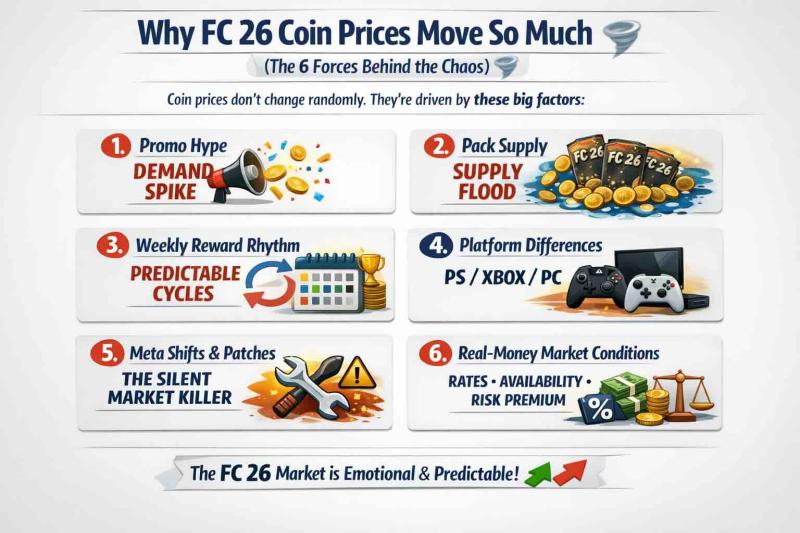
Why FC 26 Coin Prices Move So Much (The 6 Forces Behind the Chaos) 🌪️
Most people think coin prices change randomly. They don’t. The market is emotional, predictable, and driven by repeatable events. Here are the biggest drivers in FC 26:
1) Promo Hype (Demand Spike)
Whenever a new promo drops, the market gets greedy. People want the new cards, SBC fodder rises, and demand for liquid coins increases because everyone wants to move now. This is one reason coin value (and player prices) can surge fast.
2) Pack Supply (Supply Flood)
When packs are being opened heavily (promos, store packs, lightning rounds, reward days), you get more supply: more cards, more listings, more undercutting. The result is usually cheaper cards and a softer market.
This is why veterans often say: don’t buy your squad at peak hype — buy when the market is drowning in supply.
3) Weekly Reward Rhythm (Predictable Cycles)
Rivals/Champs/Squad Battles rewards inject tradable items and coins into the ecosystem on a schedule. That creates predictable “mini-crashes” and “mini-rebounds.” Even mainstream guides covering Rivals still focus on the reward cadence because it shapes weekly demand.
4) Platform Differences (PS/Xbox/PC)
Not all markets behave equally. PC supply and pricing patterns can differ from console, and market depth changes the way prices move. Even if you don’t do advanced trading, you’ll feel this when a card is “common” on one platform and weirdly expensive on another.
5) Meta Shifts and Patches (The Silent Market Killer)
A small gameplay change can make certain playstyles stronger or weaker, which instantly changes demand for specific players. When a formation becomes popular, certain roles explode in price. When the meta changes, those same cards drop like rocks.
6) Real-Money Market Conditions (Rates, Availability, Risk Premium)
Outside-game coin rates fluctuate too. Some marketplaces even publish trackers showing average prices changing week to week (useful as a reference point, not a “truth”). For example, PlayerAuctions publishes an EA FC coins price tracker with recent averages and ranges.
Coin Price vs Player Price: Here’s the Relationship Most People Miss 🔄
Players often ask: “Should I buy coins when player prices are high or low?”
The smarter way to think is: coin value is strongest when coins are scarce and demand is high, but your buying power inside the game is strongest when players are cheap.
So there’s a sweet spot: when coin rates aren’t inflated and the market is soft enough to stretch your balance. That’s usually around heavy supply periods, reward cycles, or post-promo dips.
This is also why “timing” matters more than the exact coin amount. 300k coins spent at a good time can outperform 500k spent at a terrible time.
The Best Times to Buy Your Squad (Even If You Don’t Buy Coins)
Let’s separate two actions:
- Buying players (everyone does this)
- Buying coins with real money (EA says don’t)
Even if you only earn coins, you still want to buy players at the right time.
In general (and you’ll see this echoed across market trackers and community trading posts), your best squad-buying windows are usually:
- After reward drops (more supply)
- During pack-heavy promo windows (more supply)
- After the initial “promo hype” settles (less panic buying)
If you’re building a new team, the biggest rookie mistake is buying on hype day, losing 20–30% value within 48 hours, then blaming the game.
If You’re Considering Buying Coins: What “Better Value” Really Means 🧩
I’m going to be careful here because of EA’s policy. I’m not going to teach “methods” or “workarounds.” What I can do is tell you what better value looks like in real life:
Better value usually means:
- You’re buying at a moment when the in-game market is soft (so your coins buy more)
- You’re buying with a clear upgrade plan (so you don’t waste coins impulsively)
- You’re using a provider with real support and clear processes (so you’re not dealing with scam chaos)
This is exactly why GameCurrency focuses on controlled, transparent delivery + support rather than “spray and pray” selling.
A Smarter FC 26 Coin Plan (The GameCurrency Way) 🧠⚡
Here’s what I recommend if you want a club that doesn’t collapse every time EA drops a new promo.
Step 1: Choose your “spine upgrades” first
Most matches are decided in the middle and down the centre. If your CDM can’t intercept, your CBs can’t recover, or your striker can’t finish, no amount of fancy winger dribbling will save you.
Step 2: Build around roles that survive patches
Cards tied to patch-proof roles hold value better than hype cards. Defensive mids, quick CBs, clinical strikers—these are “always useful.”
Step 3: Don’t turn coins into SBC debt
SBCs are fun. SBCs are also coin traps. If you drain your club weekly, you never build momentum. Pick the SBCs that actually improve your team or generate consistent value.
Step 4: Decide whether you’re a “grinder” or a “time buyer”
Some people enjoy earning coins through rewards and trading. Others just want to play and compete now. Both are valid. What’s not valid is switching personalities every two days 😅
If you’re the “time buyer” type and you want to top up with a reliable provider, the clean option is buy FC coins through GameCurrency — with a support team behind it, not a random seller who disappears after payment.
How to Sense-Check Coin Rates Without Getting Lost 🧾
You don’t need to be an economist. You just need a reference point.
- For in-game movement: look at a market index tool like FUTBIN to understand whether the broader market is rising or falling.
- For outside-game rate movement: trackers like PlayerAuctions can give you a rough “market temperature” (not perfect, but useful context). PlayerAuctions
If the in-game market is crashing but coin rates are inflated, your timing might be off. If the market is expensive and coin rates are inflated too, that’s usually the worst time to make any big move.
“Safe Coin Buying” — What It Should Mean (No Fairy Tales) 🛡️
A lot of websites scream “100% safe.” Real safety is calmer and more boring:
- Secure checkout and fraud protection
- Clear, consistent delivery processes
- Human support if something goes wrong
- No weird promises like “EA can’t detect this” (that’s a red flag)
EA still says don’t do it, and that’s the official truth.
So the most honest claim any serious provider can make is: we aim to reduce risk and protect the customer experience, not “we delete risk from existence.”
If you’re prioritising speed because you want upgrades before Rivals/Champs, you’ll probably care about instant fc coins delivery so you’re not waiting around while the market moves.
Conclusion: The Goal Isn’t “More Coins” — It’s “More Control” 🎮✨
Once you understand the market rhythm, coin prices stop feeling like magic. They become timing.
FC 26’s economy rewards players who are calm, intentional, and consistent—whether you’re earning coins through gameplay or choosing to top up when it makes sense. Don’t chase hype. Don’t buy your squad when the whole community is panic-buying. Don’t drain your club into SBCs you don’t even want.
And when you do decide to upgrade, do it with a plan. That’s how you build a club that lasts the whole season. 💪
Frequently asked questions

Related Blogs

FC 25 The Cheapest SBC Solvers to Avoid Overpaying
I remember I tried to do the Marquee Matchups SBC in EA Sports FC 25. I thought I was being smart by using an SBC solver, but I wasted a lot more coins than I could have because the solver wasn't taking into consideration the players I already had in my club. It was maddening, and I'm sure I know most of you have probably had that burn yourself, wasting your hard-earned FC coins on overpriced players.
A Complete FC 26 Coins Guide: Earn or Buy?
understanding how to maximize your FC 25 coins is the key to building your dream team and enjoying the game to its fullest.